
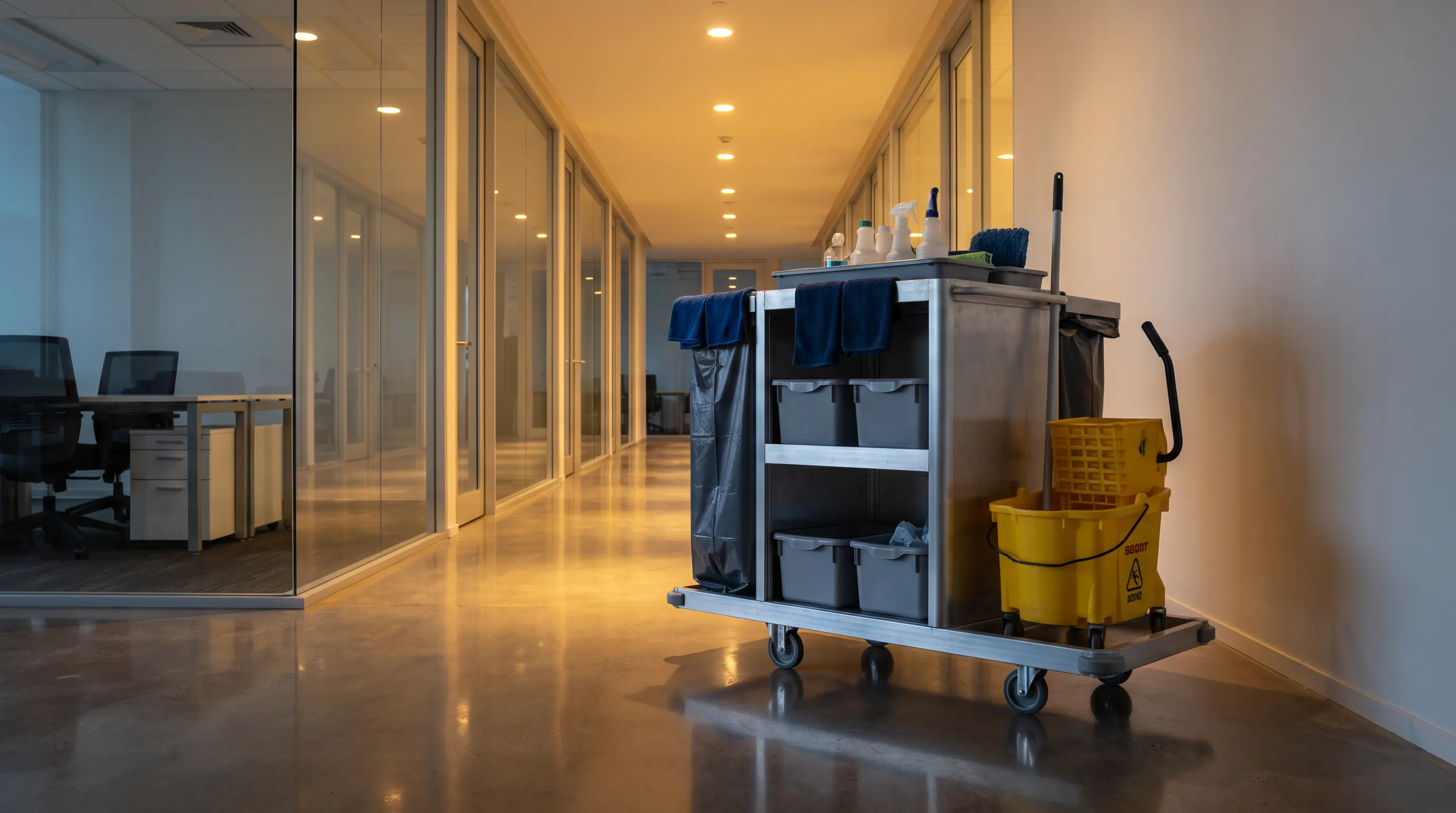
Janitorial Services St. George, UT
866SaniClean runs janitorial routes across St. George and Washington County from our office at 1031 S Bluff St, run by the same family since 1979.
What a nightly janitorial route covers
A janitorial contract is not a list of tasks. It is an attendance schedule, a written scope, and a crew that stays with your building long enough to learn it.
A route here services and restocks restrooms, clears waste and recycling, resets desks, counters and break rooms, cleans entry and interior glass, and passes the floors by surface type. It closes with a walk-through. That last step is what separates a crew catching its own misses from a tenant reporting them to you the next morning.
Restroom load usually sets the minimum attendance, whatever the square footage says. A professional suite with one restroom and a dozen staff commonly runs two or three nights a week. A busier floor sharing facilities with neighboring suites needs five. Pricing from the gross figure on a lease tends to overstate what actually needs cleaning, because corridors, mechanical space and unoccupied suites are in that number and are not in the route.
Periodic work runs on its own cycle and belongs on its own line: carpet extraction, hard floor machine work, high dusting, vents and light diffusers. Keeping those out of the nightly price is what stops them being quietly dropped when a schedule tightens. If a quote folds everything into one monthly figure, ask which of those happened last quarter.
Why St. George routes are built around dust
Washington County sits in red sandstone country, and the fine grit that comes off it is the dominant soil in local buildings. It arrives on shoes, blows in at every door, and behaves like an abrasive once it is on a floor. Ground into carpet it cuts fiber. Ground into a hard floor finish it dulls the gloss and then scratches through it.
That changes the order of work rather than the effort. Dry soil removal comes first and comes often. Dust mopping and vacuuming happen before anything wet touches a floor, because wet cleaning over loose grit turns it into a slurry that gets pushed around instead of removed. Entry matting earns its place here more than in most markets, and it has to be long enough to capture soil across several footfalls and maintained rather than left saturated.
Dry air is the other local factor. Water leaves surfaces fast, which helps carpet dry times and hurts everything with a mineral load. Local water is hard, so anything left to air dry on glass or a fixture dries to visible spotting. Glass gets a squeegee and a dry pass. Fixtures get dried rather than left wet. A descaling cycle belongs in the scope rather than in a complaint six months later.
Scope, supervision and the things buyers get wrong
Two gaps account for most janitorial disputes, and both are written problems rather than cleaning problems.
The first is the shared corridor. In a multi-tenant building, the hallway and restroom outside your suite door often sit in nobody's scope. Each tenant cleans to their own threshold, the landlord maintains the structure, and the space between collects everything. Naming those surfaces with a frequency attached costs very little at the walkthrough and nothing afterward.
The second is consumables. Paper, liners and soap can sit with the contractor or with you, and either is fine as long as it is written down. What does not work is an assumption on each side, which is how a building runs out of towels on a Friday.
Supervision is the part worth asking about directly. Our crews stay with their buildings rather than rotating through them, because access rules, alarm codes and restricted rooms are learned once and then remembered. Staff are background-checked and trained before assignment to a site. Medical practices and schools can add their own requirements on top of that.
Green cleaning as the default
Environmentally friendly, biodegradable products and energy-efficient equipment are used across the normal route rather than sold as an upgrade. EPA-tested products are used throughout. In a market this dry, water conservation is not a slogan: a route that uses less water also leaves less mineral behind, which is the practical reason it produces a better looking building here.
Buildings we cover in St. George
Offices and professional suites, clinics and dental practices, restaurants, retail along the main corridors, schools, churches, and light industrial. Each one changes the shape of the route rather than the tasks in it. A clinic concentrates its load in the waiting room. A restaurant concentrates it in front of house floors and restrooms. A warehouse wants machine work and dust control on racking rather than detail wiping.
Related work is scoped separately: carpet cleaning for extraction cycles, floor cleaning for strip, seal and scrub work, and pressure washing for exterior hard surfaces. Clinics are covered in detail on our medical and dental office cleaning page, and kitchens on restaurant cleaning.
Janitorial scope in St. George
| Cadence | Scope |
|---|---|
| Per visit | Restrooms serviced and restocked, waste and recycling out, desks and break rooms reset, entry glass, floors passed by surface, closing walk-through |
| Weekly | Detail dusting, partition and interior glass, corridor floors, high-touch pass, entry matting lifted and washed |
| Monthly | Vents and high dusting, baseboards, appliance interiors, hard floor scrub, fixture descaling |
| Quarterly | Carpet extraction, floor finish recoat, light diffusers, exterior glass |
| On request | Tenant turnover, one-time deep cleans, exterior washing with wash water containment |
Getting a janitorial quote
A walkthrough is the only honest way to price this. It takes about twenty minutes, covers cleanable area rather than leased area, counts restrooms and fixtures, identifies floor types, and settles who supplies consumables. You get a written scope with frequencies attached, and the periodic work listed separately so you can see what you are buying.
Call the St. George office on (435) 599-7859, or the main line on (866) 726-4253. Both reach the same team. You can also request a quote and we will arrange the walkthrough. The St. George hub covers how we work across Washington County, including Washington, Santa Clara, Ivins and Hurricane.
Frequently Asked Questions
How much do janitorial services cost in St. George?
Price starts from cleanable area rather than the gross figure on a lease, then moves with attendance frequency, restroom count and floor type. Periodic work sits on its own line so it is never silently dropped. Buildings in Washington County with heavy grit loads at the entrance sometimes need more frequent dry soil removal, and that shows up in the schedule rather than the rate.
How many nights a week does my St. George office need?
Restroom load usually decides it rather than floor area. A professional suite in St. George with one restroom and a small headcount commonly runs two or three nights. A busier floor sharing facilities with neighboring suites needs five. We count fixtures and watch how the building is actually used at the walkthrough instead of pricing from the square footage on your lease.
Who supplies paper, liners and soap?
Either party can, and both work as long as it is written into the scope. What fails is an assumption on each side, which is how a building runs out of towels on a Friday afternoon. We settle it at the St. George walkthrough and put it in writing, along with who restocks, how often, and where the backup stock is kept on site.
Why do restroom fixtures here look spotted after cleaning?
That is mineral rather than soil. Local water is hard and the air is dry, so water evaporates off a surface fast and leaves its dissolved mineral behind. Cleaning harder adds more water and makes it worse. Fixtures in St. George need a descaling cycle in the scope, and glass needs a squeegee and a dry pass so the water leaves before it dries on the surface.
Are your cleaning staff background-checked?
Yes. Staff undergo background checks and receive training before assignment to a site. Crews stay with their buildings rather than rotating, which matters most in Washington County clinics and schools where access rules and restricted rooms have to be learned once and remembered. Practices and campuses can add their own screening requirements on top of ours.
Do you cover Washington, Hurricane, Santa Clara and Ivins?
Yes. The same crews that run St. George routes cover Washington, Santa Clara, Ivins and Hurricane, and the office on Bluff St dispatches all of it. Scheduling across the county is built around drive time between sites, so a route in Hurricane is grouped with its neighbors rather than treated as a detour from a St. George run.
Related services and industries: St. George, Utah medical and dental office cleaning st. george, ut cleaning and commercial cleaning across St. George, Utah.