
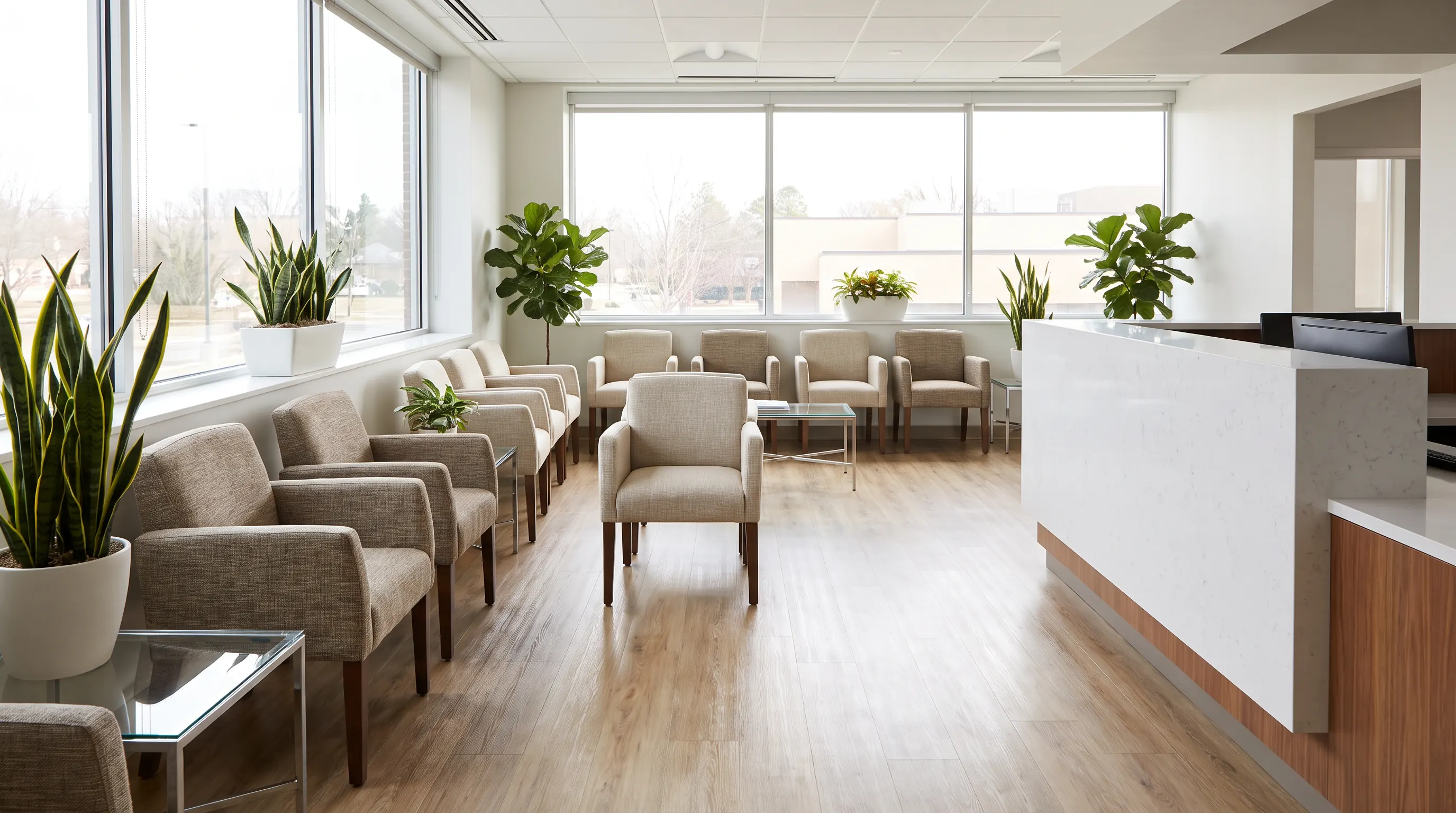
Medical and Dental Office Cleaning St. George, UT
866SaniClean cleans medical and dental practices across St. George and Washington County from our office at 1031 S Bluff St, family run since 1979.
Where our scope stops
Clinical buildings are the one setting where the boundary between what a cleaning contractor does and what the practice does has to be written down before anyone starts. Get that boundary right and the scope is straightforward. Get it wrong and both sides assume the other handled something.
Public and administrative areas are ours: waiting rooms, reception, corridors, restrooms, business offices, break rooms, staff areas and the floors throughout. Those run on a scheduled route with named frequencies.
Clinical areas stay under the practice's own infection control protocol. Treatment rooms, dental operatories, chairside surfaces, instrument areas and anything involving regulated medical waste or sharps belong to your clinical staff, who are trained and accountable for them. A contractor offering to absorb that is offering something they should not, and no janitorial crew should be making a decision about a contaminated surface.
Where the two meet is the part worth agreeing out loud. Operatory and treatment room floors, waste removal from clinical rooms once your staff have segregated it, and restocking are all commonly ours, commonly yours, and occasionally neither because nobody said. We settle each line at the walkthrough and put it in writing.
Waiting rooms carry the load
The waiting room is where a Washington County practice gets judged and where the cleaning load concentrates. It takes public traffic with no filter, in bursts tied to appointment times, often including people who are unwell and children who touch everything.
High-touch surfaces there deserve a named frequency rather than an assumption. Door handles and push plates, check-in counters and pens, chair arms, side tables, magazine racks, water stations, toy surfaces where a practice still has them, and the restroom immediately off the waiting area. "Daily" is not a frequency for a surface that two hundred people touch between nine and five. Where a practice has real daytime volume, the answer is coverage through the day rather than a thorough clean after everyone has gone home.
Upholstered waiting room chairs are the most neglected surface in local clinics. They are fabric, they are touched constantly, and they are rarely in anyone's written scope.
Dental practices specifically
Dental offices have a different shape from medical ones. The operatories are small, numerous and densely equipped, and the practice handles them. What falls to us is everything around them: corridors, the sterilization area floor, the lab area floor, restrooms, reception and the business office.
Dental buildings also run harder on plumbing fixtures, and that is where local water shows up. Hard water in St. George leaves mineral on every fixture, and in a clinical setting a scaled fixture reads as a hygiene problem whether or not it is one. Descaling goes into the scope on a cycle rather than being attempted with more scrubbing.
Most newer local practices are on luxury vinyl plank rather than VCT. That matters because LVT should not be waxed. It is maintained with neutral cleaning and machine scrubbing, and applying floor finish to it is a mistake that costs real money to undo. We identify what is actually on your floor before touching it.
Access, privacy and crew continuity
Clinical buildings have access rules, alarm codes, rooms that stay locked and records that must not be disturbed. That is the reason we keep crews with their buildings rather than rotating them. Those rules get learned once and then remembered, and the alternative is a new person every few weeks being briefed by whoever is still in the building at six o'clock.
Our staff are background-checked and trained before assignment to a site, and practices can add their own screening and orientation requirements on top. Crews work around charts, screens and paperwork rather than moving them.
Scheduling usually runs after the last appointment. Practices with long clinic hours sometimes need an early morning route instead, and practices with heavy waiting room volume often end up with both a daytime presence and a nightly route, because neither covers the other's hours.
Hard surfaces, air and the local dust load
Red grit tracked in from St. George parking lots is abrasive, and in a clinical setting it is also what makes a floor look tired at ten in the morning. Entry matting sized for several footfalls plus dry soil removal before any wet work does more for a clinic's appearance than anything applied later.
Vents, returns and high surfaces matter more in a waiting room than in an office, because that dust is visible from a seated position and it carries the local sediment load. Those go on a monthly cycle rather than being left to a once a year deep clean.
Related scopes: janitorial services for the nightly route, floor cleaning for hard floor restoration, carpet cleaning for waiting room carpet, and pressure washing for the entry outside. The St. George hub covers the rest of Washington County.
Clinical building scope in St. George
| Cadence | Scope |
|---|---|
| Daytime where scoped | Waiting room and restroom rounds, high-touch pass, entry glass, spill response, trash rotation |
| Per visit | Restrooms serviced and restocked, reception and corridors, waste out, floors by surface, closing walk-through |
| Weekly | Detail dusting, interior glass and partitions, upholstered seating, baseboards, matting washed |
| Monthly | Vents and returns, high surfaces, fixture descaling, appliance interiors, machine scrub on hard floors |
| Quarterly | Waiting room carpet extraction, hard floor recoat where applicable, light diffusers |
| Always yours | Treatment rooms and operatories, clinical surfaces, regulated medical waste and sharps |
Booking a clinical walkthrough
Call the St. George office on (435) 599-7859 or the main line on (866) 726-4253. You can also request a quote. The walkthrough covers the boundary line first, then fixtures, floor types and waiting room volume, and you get a written scope that names which surfaces are ours and at what frequency.
Frequently Asked Questions
Do you clean treatment rooms and dental operatories?
No. Those stay under your own infection control protocol, along with clinical surfaces, regulated medical waste and sharps. Our scope covers public and administrative space: waiting rooms, reception, corridors, restrooms, break rooms and the floors. We agree the overlap at the St. George walkthrough, including operatory floors and segregated waste removal, so nothing sits in a gap between us.
How often should a waiting room be cleaned in a busy clinic?
More often than once a night if your St. George practice has real daytime volume. A waiting room takes unfiltered public traffic in bursts tied to appointment times, so the high-touch surfaces need a named frequency through the day rather than a thorough pass after close. Many Washington County practices end up with daytime coverage and a nightly route, because neither replaces the other.
Why do clinic fixtures here look scaled so quickly?
Hard local water. Every gallon leaves dissolved mineral behind as it evaporates, and the dry St. George air speeds that up. In a clinical setting a scaled fixture reads as a hygiene problem regardless of whether it is one. Scrubbing harder adds water and makes it worse, so descaling belongs in the scope on a cycle, which is how we write it.
Can you wax the floors in our dental office?
Probably not, and it is worth checking before anyone tries. Most newer St. George practices are on luxury vinyl plank, which is maintained with neutral cleaning and machine scrubbing and should never be waxed. Applying finish to it is expensive to reverse. We identify the actual product and any existing coating during the walkthrough and scope the right method for it.
Are your staff background-checked for medical buildings?
Yes. Staff undergo background checks and training before assignment to a site, and Washington County practices can add their own screening and orientation on top. We keep the same crew with your building rather than rotating people through it, because access rules, alarm codes and locked rooms in a clinical setting should be learned once and then known.
When do you clean around our appointment hours?
Usually after the last appointment, which suits most St. George practices. Clinics running long hours sometimes take an early morning route instead. Where waiting room volume is heavy, a daytime porter presence plus a nightly route is the honest answer, since the systematic work needs an empty building and the waiting room needs attention while people are in it.
We also clean commercial cleaning across St. George, Utah.