Cleaning Services for Buildings Property in Orange County California
866SaniClean handles commercial building cleaning in Orange County for property managers and owners running multi-tenant office, medical and mixed-use buildings.
Where landlord scope ends and tenant scope begins
Scope covers lobbies, elevators, corridors, stairwells, shared restrooms, parking areas and vacant suites, managed under one named contact for the whole portfolio.
The property manager is rarely the person who sees the cleaning. Tenants see it, prospects on a leasing tour see it, and the manager hears about it afterwards. One family has owned and run 866SaniClean since 1979, and our building scopes are written so problems reach us before they reach your inbox.
Most complaints in a managed building start at a boundary nobody wrote down. A restroom serving three suites, a corridor outside one tenant's door, a kitchen shared by two firms: each one needs an owner in the contract before the first visit.
The usual split puts every space a tenant cannot lock under the landlord's common-area agreement, and everything inside a suite under the tenant's own arrangement. Exceptions are common. Full-floor tenants often take their floor's restrooms in-house, and some leases bundle suite cleaning into operating expenses.
We map the building floor by floor during the walkthrough and mark each room as landlord, tenant or shared. That map goes into the written scope, so a crew never has to decide on the night whether a room is theirs.
The same map settles requests. When a tenant reports a spill or a failed restroom, the crew already knows whether the job falls under your contract, so the fix happens that night instead of after a round of emails about who pays. Supplies follow the same logic: we record whether paper, soap and liners are stocked by us, by you or by each tenant.
Commercial building maintenance in Orange County, the cleaning side
Commercial building maintenance in Orange County covers far more than cleaning, and we do not pretend otherwise: HVAC, roofing and repairs belong to your engineers and trades. What we carry is the recurring cleaning work that keeps a building's finishes from wearing out early.
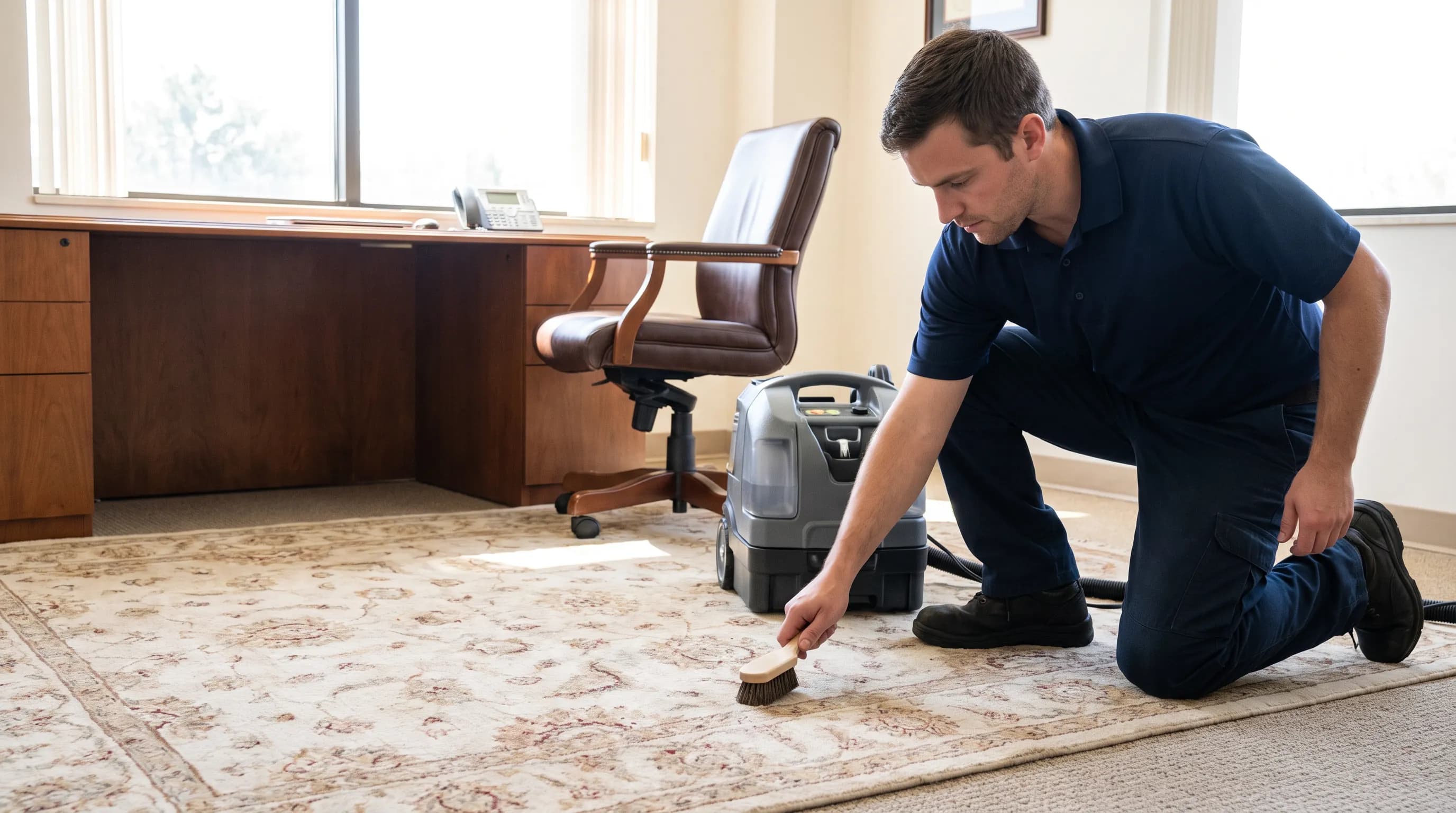
That work runs on cycles longer than a night. Lobby stone gets burnished, elevator cab floors get machine scrubbed, carpet in corridors gets extracted, and high ledges, vents and light lenses get dusted from access equipment. None of it shows on a single visit, which is why it is the first thing cut when a nightly price is squeezed.
We list each periodic item as its own line with its own frequency. Building maintenance budgets in Orange County are planned a year ahead, and separate lines let you see exactly what you are buying instead of trusting a blended figure.
Multi tenant building cleaning that holds between visits
Multi tenant building cleaning is judged on the hours between visits, not the visit itself. A lobby that is spotless at 6 a.m. and grimy by noon reads as neglect to every tenant who walks through it.
The traffic pattern decides frequency. Elevator panels and lobby doors take hand contact all day. Shared restrooms on busy floors fail by early afternoon. Ground-floor entries collect grit off the parking lot, and in coastal buildings from Newport Beach to Dana Point they collect sand as well.
For buildings where a night route is not enough, daytime porter hours fill the gap; our day porter coverage in Orange County explains how those hours are scoped. Crews stay with their buildings, so the porter and the night crew know the same tenants and the same trouble spots.
Exteriors, parking structures and stormwater
The outside of a building is the first thing a prospect sees, and in Orange County it carries a legal obligation the inside does not. Exterior washing has to keep its water out of the storm drain.
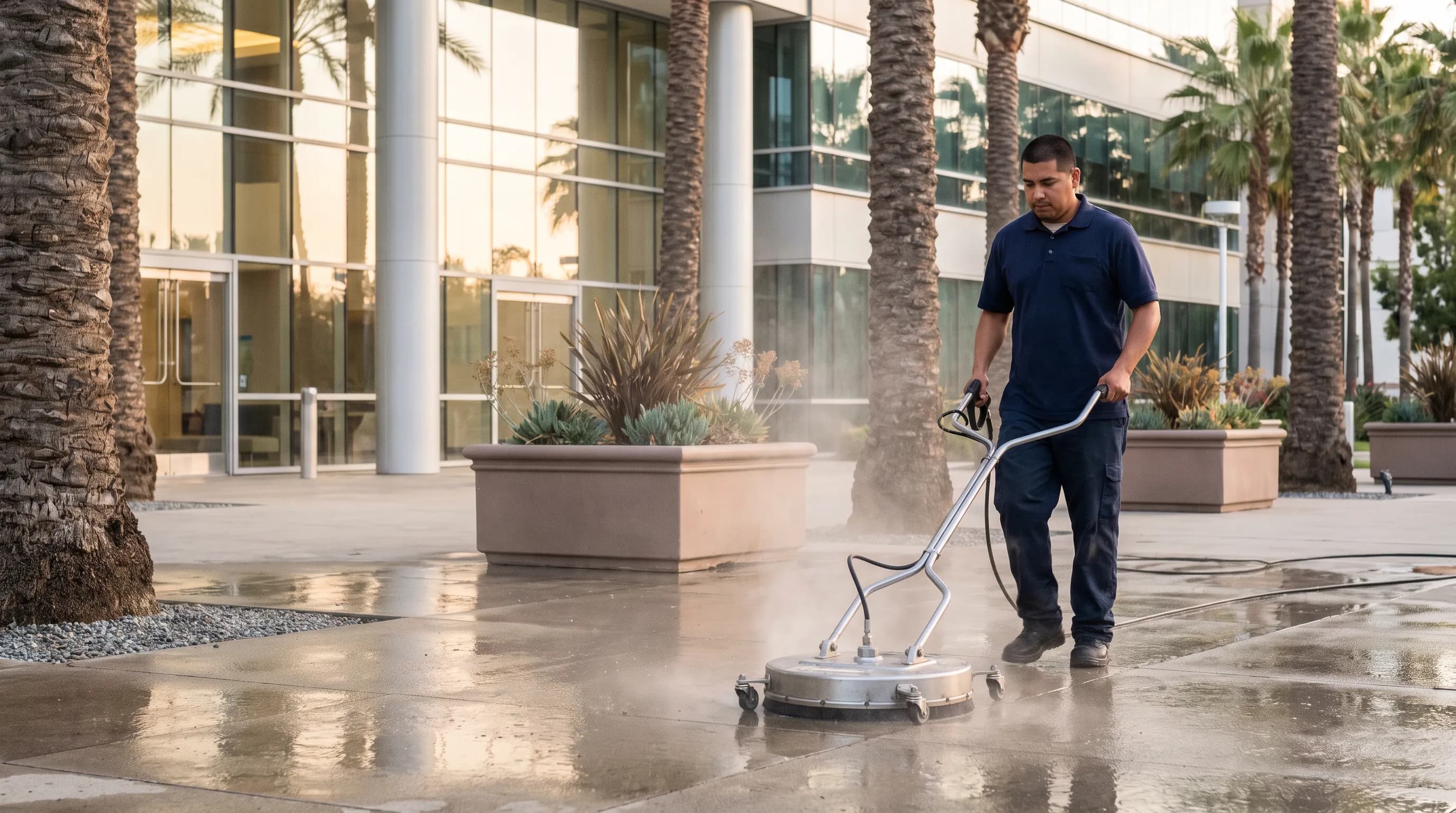
Non-stormwater discharges into the county's storm drain system are prohibited under the Orange County MS4 permit unless specifically authorized, and those drains carry water untreated to creeks and the ocean. Washing a parking deck or an entry plaza therefore means plugging drains, containing the water, recovering it and disposing of it properly. Our commercial pressure washing in Orange County page sets out that process.
Parking structures also need routine sweeping, stairwell cleaning and elevator lobby service between washes. Oil drips near pay stations and ramps are a slip hazard as well as a stain. Stairwells in older structures also collect windblown leaves and litter, which settle on treads where people least expect them.
Property management cleaning across an Orange County portfolio
Property management cleaning across several buildings works best under one agreement with separate scopes. One contact, one escalation path and comparable standards let a manager see which property is drifting before a tenant does.
Portfolios here are spread out. A manager might hold a garden-office park in Irvine, a medical plaza in Fullerton and a retail strip in Costa Mesa. Each keeps its own frequencies, access rules and periodic schedule, because the buildings have little in common beyond the owner.
Vacant suites are priced as defined jobs: a turnover clean when a tenant leaves, and a pre-tour clean before a space is shown. Office tenants inside your buildings can be covered under our office and co-working cleaning approach, and retail properties under shopping center common-area cleaning. There are no long-term contracts.
| Cadence | Scope |
|---|---|
| Per visit | Lobby and entry floors, elevator cabs and panels, shared restrooms, corridor vacuuming, trash and recycling, door glass |
| Weekly | Stairwell sweep and rail wipe, elevator door tracks, management office, parking lobby, baseboards |
| Monthly | Lobby stone burnishing, high dusting, vents and light lenses, elevator floor machine scrub |
| Quarterly | Corridor carpet extraction, parking structure sweep and contained wash, exterior entry glass and metalwork |
| As needed | Vacant suite turnover cleans and pre-tour cleans, priced as defined jobs |

Frequently Asked Questions
What does common-area cleaning cover in a multi-tenant building?
Common-area scope covers the lobby, elevators and tracks, corridors, stairwells, shared restrooms, loading areas and the management office. Tenant suites sit under separate agreements unless ownership prefers a single provider. Orange County properties with exterior corridors and open-air stairwells, common in older garden-office parks, also need those walkways in scope because weather brings dirt straight into them.
How does cleaning affect tenant retention and leasing tours?
Prospective tenants tour during business hours and see the building as it actually runs, not as the night crew left it. Lobby glass, elevator interiors and restrooms carry disproportionate weight, because a visitor passes through them unaccompanied. Orange County office vacancy gives tenants real choice, so managers who add daytime coverage usually do it after losing a tour rather than before.
What does common-area cleaning cost for an Orange County property?
Cost follows common-area square footage rather than the building's gross area, the number of floors and restrooms, elevator count, service frequency, and whether daytime porter coverage is included. A building with one shared restroom per floor prices differently from one with restrooms in each suite. We walk the property with the manager and scope against common areas specifically.
How are tenant complaints handled between scheduled visits?
Your property has a named contact, and requests reach the crew directly rather than through a general queue. Common-area complaints are time-sensitive, since a restroom failure or lobby spill affects every tenant at once. California employers also carry an Injury and Illness Prevention Program duty under Cal/OSHA Title 8, and unaddressed spills in shared circulation space sit squarely inside it.
How do you handle elevators and stairwells?
Elevator interiors need daily attention on panels, handrails and floors, with tracks cleaned regularly because grit there causes door faults as well as looking neglected. Stairwells are the most neglected space in most managed buildings. Orange County properties with exterior stairs get leaf litter and wind-blown grit on treads, which is a slip issue rather than a cosmetic one.
Can you service several properties in a portfolio on one agreement?
Yes. Managers running multiple Orange County buildings usually consolidate under one agreement with a consistent scope, which makes standards comparable across the portfolio and gives one escalation path. Individual buildings keep their own frequencies and access rules, since a two-story suburban property and a mid-rise with parking structure rarely need the same schedule.