Gym Floor Cleaning: How to Clean Rubber, Turf and Hardwood Without Ruining Them
By 866SaniClean Team
Gym floors are cleaned by surface, not by building. Rubber wants a neutral pH cleaner and a soft-pad autoscrubber that lifts sweat out of the texture. Turf wants dry maintenance, vacuuming with real agitation and periodic infill grooming, with wet mopping avoided entirely. Hardwood courts want daily dust mopping, a damp tack pass with a cleaner made for wood finish, and screen-and-recoat on a cycle instead of aggressive wet cleaning. Mats and pads want disinfection on the surfaces that touch bare skin. Get the pairing wrong on any one of them and the floor does not just look worse, its life gets shorter.
Most floors in a fitness facility do not wear out. They get cleaned to death, usually with a product that was correct for a different surface twenty feet away.
Why Gym Floors Fail Early
A gym attacks flooring in ways an office never does, and the damage is cumulative rather than dramatic.
Sweat is the first problem. It is saline, it lands constantly, and the salts it leaves behind hold moisture and dull the surface as they build. Rinsing matters as much as cleaning here, because a floor cleaned without a proper recovery step is a floor that keeps its salt film.
Disinfectant residue is the second and the most misunderstood. Quaternary products leave a film by design, and when they are applied repeatedly without rinsing, that film builds into something tacky that grabs soil and can turn slick underfoot. Members read it as a dirty floor. It is actually too much product with nowhere to go.
Wrong-chemical damage is the third, and it is the expensive one. A high-pH degreaser that is right for a kitchen will break down the binders in rubber. A general-purpose cleaner that is fine on vinyl will cloud a wood finish. Nothing announces the mistake on the first pass, which is exactly why it continues for months.
Grit is the fourth. Sand and dirt tracked in from the parking lot behave like sandpaper under foot traffic and under equipment wheels. Entry matting and a genuine daily dust-mop routine do more for floor life than any periodic deep clean.
One standards point is worth stating precisely, because it is where good intentions usually go wrong. The EPA's List N covers products expected to kill SARS-CoV-2 when used according to label directions, and the label's contact time is the part gyms skip: the surface has to remain visibly wet for the full contact time to do anything. Each product is also registered for particular surface types rather than for every floor in the building, so a disinfectant cleared for hard nonporous surfaces is not automatically cleared for a porous one.
Cleaning Rubber Gym Flooring
Rubber sits under the free weights and the machines, and it is the surface most often destroyed by cleaning rather than by use.
Rubber is porous. It reacts badly to high-pH degreasers, solvents and citrus cleaners, all of which attack the binders holding the material together. The result is a surface that goes tacky, then permanently dull, and no amount of subsequent cleaning brings it back. Neutral pH is not a preference here, it is the rule.
Daily work is straightforward: dust mop or vacuum to pull the grit out, then spot clean where chalk and body oil collect around benches and racks. Weekly is where the machine earns its place. An autoscrubber with a soft pad applies solution, agitates it, and recovers it in one pass, which is the whole point. A mop cannot do that. A mop distributes soil in progressively dirtier water and leaves the residue behind to dry.
Two habits shorten rubber floors more than anything else. The first is letting solution sit in the seams between tiles, where it works into the subfloor and lifts edges over time. The second is scrubbing with an aggressive pad because the floor looks dull, when the dullness is residue that a neutral rinse would have removed. If a rubber floor has gone hazy, the answer is usually less product and better recovery, not more pressure. Rubber is the surface we are asked to rescue most often on gym cleaning services in Orange County, and by the time it is tacky the damage is rarely reversible.
Cleaning Gym Turf
Functional training turf hides more than any other surface in the building. The fibers look clean while the infill underneath holds sweat, skin cells, and whatever arrived on the bottom of a shoe.
Turf is maintained dry. Vacuuming needs a machine that agitates the pile rather than passing over it, because the point is to lift material out of the infill and not simply to groom the top. Grooming with a brush keeps the fibers upright, which matters for both appearance and for how the surface plays under a sled.
Extraction is periodic rather than routine, and it is a specialist job. Low-moisture sanitizing treatments handle the odor and bioburden between extractions. The cadence depends entirely on use: a sled track in a busy functional area needs attention on a much tighter cycle than a turf strip that gets used for warmups.
The one thing not to do is wet mop it. Mopping turf pushes contamination down into the infill and the backing, where it stays damp, and damp organic material in a warm room is precisely how a facility develops the smell that members mention in reviews. Odor control on turf is a drainage and extraction question, not a fragrance question.
Cleaning Hardwood Courts
A wood court is a finish system rather than a floor, and every decision follows from that.
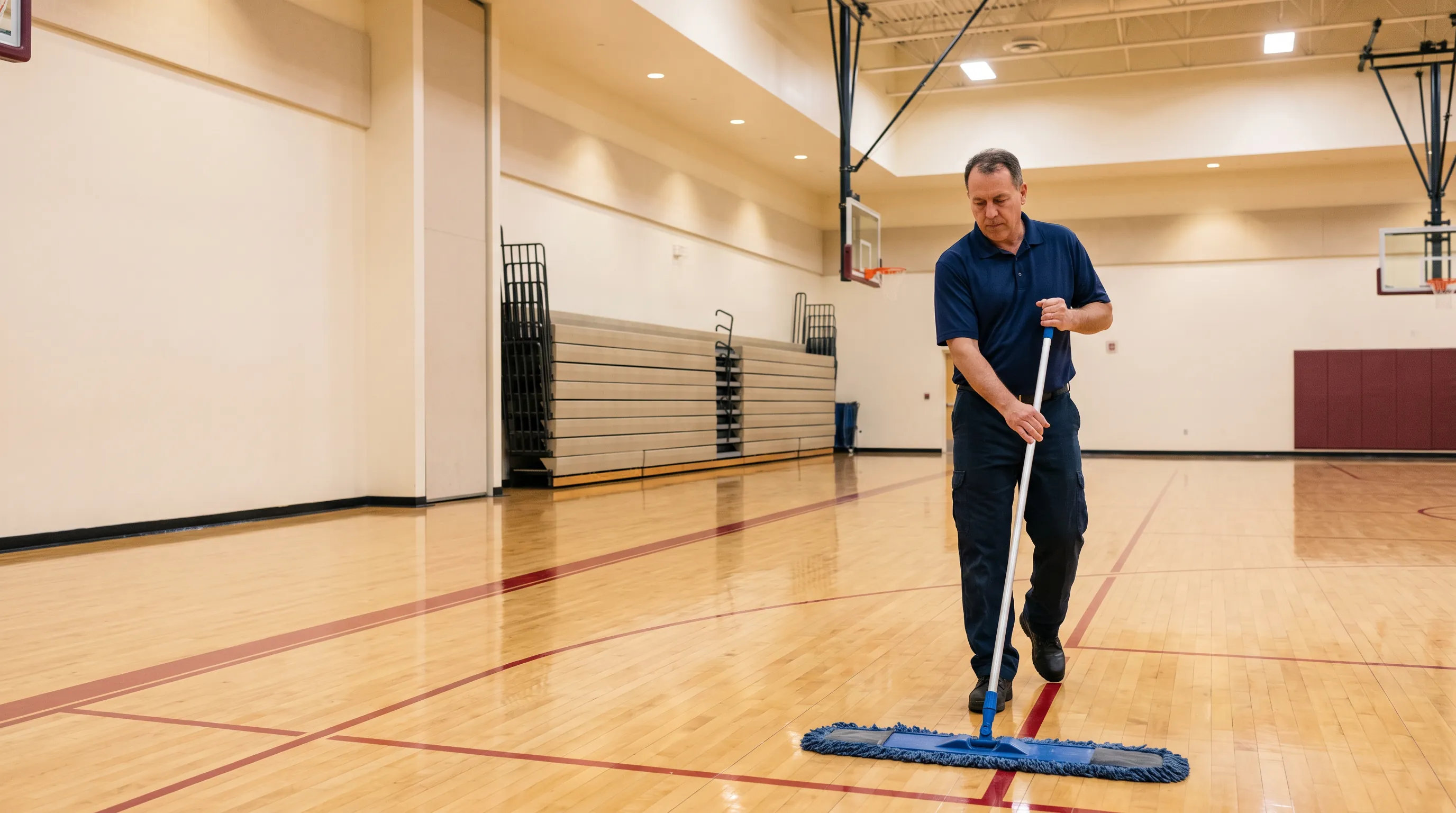
Daily dust mopping is the entire foundation. Grit left on a court gets ground into the finish by shoes, and the micro-scratching that results is what makes a floor look tired long before it is worn. A large dust mop, used daily and laundered regularly, protects more finish than any product does.
Damp cleaning comes next, with a cleaner made for wood floor finish, applied as a tack pass rather than a wet one. Standing water is the enemy. It penetrates seams, swells board edges, and clouds the finish, and the damage is permanent in a way that scuffing is not.
Screen-and-recoat is the maintenance cycle that keeps a court alive. Screening abrades the existing finish just enough for a fresh coat to bond, which restores appearance and rebuilds the wear layer. A busy club often runs this annually. Full sand-and-refinish, which takes the floor back to bare wood, is a much longer cycle, and how long depends almost entirely on whether the recoats were kept up. Skipping recoats does not save money, it converts a cheap job into an expensive one.
Climate control belongs in this section because wood responds to it. The Maple Flooring Manufacturers Association recommends keeping the space between 55 and 75 degrees Fahrenheit, and holding indoor relative humidity within a 15 percent band, for example 35 to 50 percent. The association's reasoning is that limiting wide swings reduces the expansion and contraction that comes with seasonal changes. A court that is allowed to swing between a humid summer and a dry heating season will move, and movement opens gaps that trap grit against the finish.
Mats, Pads and Functional Zones
Mats and equipment pads are the surfaces where cleaning stops being about appearance.
These are the places bare skin actually touches: stretching mats, machine pads, bench upholstery, and the turf and rubber immediately around them. Skin infections spread in athletic facilities through that contact and through shared equipment, with staph and MRSA, along with fungal infections such as ringworm and athlete's foot, being the ones facilities plan around.
CDC guidance for athletic facilities is refreshingly specific. Focus on the surfaces that come into direct contact with bare skin each day. Clean shared equipment after each use and let it dry before the next person uses it. CDC also notes that there is little evidence large-scale disinfectant use prevents MRSA better than a targeted approach of cleaning those surfaces, which is a useful corrective for any facility that has been sold fogging as a substitute for wiping down a bench. For MRSA claims specifically, the relevant EPA product list is List H rather than List N.
Practically, that means wipe-down stations members actually use, a nightly disinfection pass on every skin-contact surface, and a rotation that pulls mats out for full submersion or extraction cleaning rather than surface wiping forever. Clubs with heavy daytime traffic often put this on a staffed daytime schedule, which is the model our day porter services guide describes in full.
The Gym Floor Cleaning Schedule
This is the reference table. Frequencies assume a working commercial facility, and heavy use tightens every column.
| Surface | Daily | Weekly | Monthly | Quarterly |
|---|---|---|---|---|
| Rubber | Dust mop or vacuum, spot clean around racks | Autoscrub, neutral pH, soft pad | Detail seams and edges, inspect for lifting | Deep scrub and full rinse recovery |
| Turf | Vacuum high-traffic lanes, remove debris | Full vacuum with agitation, brush groom | Infill grooming and level check | Extraction and low-moisture sanitizing |
| Hardwood court | Dust mop, spot clean spills immediately | Tack clean with a wood-finish cleaner | Inspect finish wear and moisture readings | Deep tack clean, plan screen-and-recoat |
| Mats and pads | Disinfect all skin-contact surfaces | Detail seams, straps and undersides | Rotate for submersion or extraction clean | Inspect for tears and replace |
| Entry matting | Vacuum both sides, clear grit | Extract or launder | Assess coverage and length | Replace worn runs |
The pattern to notice is that daily work is cheap and protective while quarterly work is expensive and corrective. Facilities that skip the first column pay for it in the fourth.
When In-House Staff Is Enough, and When It Is Not
Not every gym needs a contractor, and it is worth being honest about where the line sits.
In-house staff genuinely suffices for the daily layer. Dust mopping, spot cleaning, wiping skin-contact surfaces, emptying bins, and keeping entry mats clear are all routine tasks that a trained member of your own team can do well, and doing them consistently matters more than doing them expertly.
The line is equipment and irreversibility. Autoscrubbers, turf extractors and wood screening machines are capital purchases that need maintenance and training, and the tasks they perform are the ones where a mistake is permanent. Screening a court incorrectly means refinishing it. Running the wrong chemistry on rubber means replacing it. Extracting turf badly means a wet backing and a smell that outlasts the mistake by months.
A reasonable split for most clubs is daily in-house, periodic contracted. Your team owns the first column of the table above, a contractor owns the machine work and the finish work, and someone writes down which is which so the boundary does not blur. We cover that division for fitness facilities on our gym and fitness center cleaning page, and the machine and finish work itself on our commercial floor cleaning page.
The other honest threshold is time. A facility that is open sixteen hours a day has a narrow window for machine work, and squeezing it into the end of a closing shift is how corners get cut. If your team is already finishing late, adding floor machine work to their night is not a saving.
See also our pages on commercial cleaning across Orange County.