
Day Porter Services: What They Are, What They Cost, and Whether Your Building Needs One
By 866SaniClean Team
What Is a Day Porter?
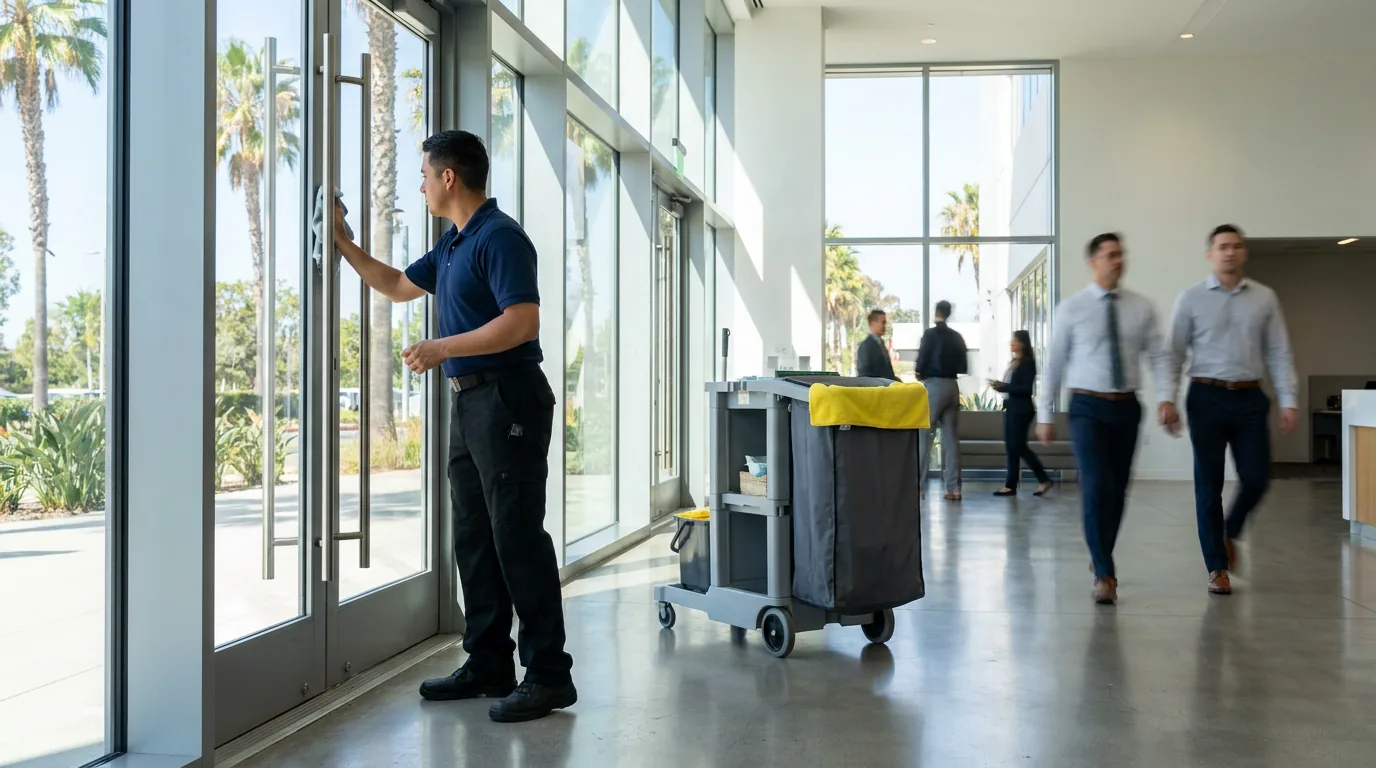
A day porter is a cleaning professional who works inside your building during business hours, keeping lobbies, restrooms, break rooms and other shared spaces presentable while people are using them. Hiring the service means a cleaning company staffs that position on a defined schedule, supervises the work and covers absences. The porter handles upkeep and response in real time, which a night crew cannot do because it arrives after everyone has gone home.
The phrase means two different things online. Many search results are job listings, because day porter is also a job title. This guide is for the other half: the owner, property manager or facilities lead deciding whether to hire a porter service and how to buy well. If you want porter jobs, a job board will serve you better.
Everything below applies to any occupied commercial building in the country. Our family has run commercial cleaning since 1979 and provides day porter services in Orange County, but the buying decision looks the same in Denver or Atlanta.
What a Day Porter Does, Hour by Hour
A porter's shift is a loop, not a list. Here is a full-day route in a mid-size multi-tenant building.
Opening and mid-morning
Before the lobby fills, the porter checks entry glass, wipes door hardware and straightens mats. Every restroom gets a first inspection: paper stocked, soap full, floors dry. Restroom cycles then begin, covering restocking, counters and mirrors on each pass. Between passes the route hits break rooms as the coffee rush ends, and trash is pulled before containers fill.
Spill and incident response
Spill response runs all day and overrides the schedule. A porter reachable by phone or text drops the current task, cordons the area, cleans the spill and dries the floor. OSHA's walking-working surfaces rule, 29 CFR 1910.22, requires employers to keep floors clean and, to the extent feasible, dry, and to keep walking-working surfaces free of hazards such as spills. With nobody on site, a spill stays a hazard until reported.
Midday and afternoon
Lunch is the heaviest hour for break rooms and restrooms, so rounds tighten: a full break room reset after the rush and attention to high-touch surfaces. CDC guidance holds that a surface must be cleaned before it is disinfected, and that frequently touched surfaces should be cleaned, and disinfected where appropriate, at least daily or more often depending on use. A porter is what makes "more often" possible.
The afternoon is common-area work: lobby seating, fingerprints off glass, stairwell handrails, elevator tracks, the exterior entry. Conference rooms get turned between meetings, and recycling is pulled before the evening.
Events and closing
If a tenant hosts an event, the porter sets the room beforehand, clears it afterward and resets the nearest restrooms. The shift ends with a closing handoff to the supervisor and the night crew: what needs deep work, which supplies are low and any maintenance issue spotted during the day.
Duties by frequency
| Frequency | Typical porter duties |
|---|---|
| Continuous | Spill response, tenant requests, entry glass and door hardware, trash pulled before overflow. |
| Hourly-ish rounds | Restroom inspection and restocking, lobby seating, break room spot checks, elevator cabs. |
| Daily | Break room full reset, wipe-down of high-touch surfaces, entry sweep, supply inventory, closing handoff. |
| Weekly | Common-area detail dusting, stairwell handrails, interior glass, directory and signage, supply order. |
Day Porter vs. Janitorial Service
Buyers often ask whether a day porter replaces the night crew. It does not, and a vendor who says otherwise is selling you fewer hours.
Nightly janitorial is systematic. The crew works a fixed scope with nobody around: every restroom fully cleaned and disinfected, every floor vacuumed or mopped, periodic machine floor work. Porter coverage is responsive. The porter keeps the building presentable during the hours it is judged and handles what appears between night visits.
| Day porter service | Nightly janitorial | |
|---|---|---|
| Hours | During occupancy, on a set shift | After hours, building emptied |
| Visibility | Seen by tenants, visitors and staff | Rarely seen by anyone |
| Scope | Upkeep, restocking, response, resets | Full cleaning on a fixed scope |
| Restrooms | Inspected and restocked several times a day | Complete clean and disinfection nightly |
| Floors | Spill response, mat upkeep, spot cleaning | Vacuuming, mopping, machine work |
| Catches | Spills, outages and tenant issues as they happen | Accumulated soil, detail work, periodic tasks |
| Misses | Deep cleaning, floor care, detail work | Anything that happens between 8 a.m. and 6 p.m. |
Each catches what the other misses. Once daytime traffic is heavy enough that the morning-after state does not last until noon, the two services become halves of one program. That is why most buildings above a few tenants run both, usually from one vendor so the closing handoff reaches the night lead. Our janitorial services in Orange County are offered alongside porter coverage for that reason.
Who Needs a Day Porter, and Who Does Not
Walk your common areas at 2 p.m. on a Wednesday. If they look acceptable without anyone having touched them since the night crew left, you do not need a porter. If they do not, you are already paying for the problem in complaints, tenant goodwill and slip risk.
Multi-tenant office buildings
The lobby, elevators and shared restrooms belong to the building, so no single tenant looks after them. Once a building has several tenants across multiple floors and a steady flow of visitors, restroom supplies do not last the day and lobby glass does not stay clean.
HOAs and residential common areas
Amenity spaces run seven days a week and peak on weekends, when no night crew is scheduled. Communities with a staffed clubhouse, an on-site gym or a busy package room usually reach the threshold. A small association with a mail kiosk and a landscaped path usually does not.
Retail centers
Retail restrooms and entrances see a new group of people every few minutes. Centers with shared restrooms, a food component or long operating hours almost always need coverage. A strip center where every tenant maintains its own space, with no shared restroom, typically needs exterior sweeping instead.
Medical office buildings
Patients judge care by the state of the waiting room. Shared restrooms and lobbies in a multi-practice building need attention between the morning and afternoon patient blocks. Buildings in dense medical corridors, like those our commercial cleaning crews in Garden Grove serve, tend to pair a porter with clinic-specific after-hours work.
Who does not need one
A single-tenant office with a small staff, one or two restrooms and light visitor traffic is well served by a nightly route. Supplies last the day and spills get handled by whoever made them. The same holds for warehouses with small office components and suites where the receptionist keeps the front presentable. A vendor pushing daytime coverage on a building like that is selling hours, and you can say no.
What Day Porter Services Cost
No honest number fits a national guide, because the price of porter coverage is the price of labor on your schedule, and your schedule is the variable.
Factors that set the price
- Hours of coverage. A four-hour morning shift is a different contract from two overlapping shifts spanning open hours.
- Single porter or several. Large buildings, campuses and centers with multiple restroom banks may need more than one person on site at once.
- Scope breadth. A restroom-and-lobby route costs less than one that also includes conference room turns, event support, exterior work and loading dock checks.
- Building type and traffic. Retail and medical generate more restroom cycles and spills per hour than office, so the same hours cover less ground.
- Supply responsibilities. Whether the vendor buys and stocks paper, soap and liners, or you do, changes the monthly figure and who tracks inventory.
- Weekend and event coverage. Saturday hours, holiday hours and on-call event support are priced separately from the weekday route.
Hourly coverage versus a flat monthly fee
Vendors price porter work two ways. The hourly model bills per porter hour against an agreed schedule, so the invoice moves when hours move. The flat model bills a fixed monthly fee for a defined schedule and scope, with changes by amendment. Both are market-normal; neither is inherently cheaper.
To compare them, ask every bidder for the same package: weekly hours, porter count, supply arrangement and scope document. Then convert. Divide a flat fee by scheduled monthly hours to get an effective hourly rate; multiply an hourly bid by scheduled hours to get a monthly figure. If the numbers diverge sharply, one scope is leaving something out; find out what.
Where bad contracts go wrong
Most porter contracts fail on scope, not price. One pattern is a low hourly rate on a vague scope, then change orders for everything the scope did not name. The other is a flat fee with no stated hours, which lets the vendor quietly shorten the shift when labor is tight. Insist on a scope document listing the areas covered, the round frequency for each and the hours on site, and have the invoice reference it.
How to Evaluate a Day Porter Company
Any competent vendor should pass every item below without friction. Treat hesitation on any of them as information.
Staffing and cover for absence
Ask who your porter will be, how long that person has been with the company, and what happens on the day they call in sick. The right answer names a specific mechanism: a floater, a supervisor who steps in, a trained backup who already knows your building. "We'll send someone" is not an answer.
Supervision model
A porter nobody checks on gradually does less. Ask how often a supervisor visits the site, whether visits are announced, what gets inspected and how the results reach you. Ask whether the porter logs rounds in an app or on paper, and whether you can see that log.
Insurance verification
Request a certificate of insurance naming your property as the certificate holder, and read it. Confirm general liability and workers' compensation are active and the limits meet your lease or management agreement. Ask whether staff undergo background checks; ours do, and any vendor placing a person in your building should be able to say the same.
Scope documentation
The scope is the contract. It should list every area covered, the round frequency for each, the hours on site, supply responsibility and how out-of-scope requests are handled and priced. If the vendor never walked the building before quoting, the scope came from a template, and the misfits show within a month.
The tenant communication channel
Ask how a tenant reaches the porter at 10:40 a.m. when a restroom needs attention. The channel matters more than the technology: a dedicated number, a text line, a request form that pings the porter directly. Avoid any path that routes through the vendor's office and waits for a callback. Ask the target response time and how the vendor knows it is met.
References from similar buildings
Ask for two or three references from properties like yours, same building type, size and traffic, and call them. Ask how long they have used the vendor, how many porter changes they have seen, how sick-day coverage actually worked and whether the scope matched the invoice. We have completed more than 1,000 projects for more than 170 clients; ask any vendor for the same depth.
Making the Decision
If your common areas do not hold up between night visits, the question is how many hours and under what scope, not whether. Walk the building, get the scope in writing, price it both ways and check references.
Our family has run commercial cleaning since 1979 and offers day porter services in Orange County; the diligence above is what we expect a careful buyer to run on us.
See also our pages on commercial cleaning across Orange County.