Cleaning Services for Industrial Warehouses In Orange County California
866SaniClean provides warehouse cleaning across Orange County for distribution buildings, manufacturing floors and cold-adjacent storage.
Cleaning as preventive maintenance
We treat the work as facility maintenance rather than tidying, because in an industrial building the two are the same thing. Dust, grease and debris shorten equipment life, foul product and create the conditions that inspectors write up.
We have cleaned commercial and industrial buildings as a family business since 1979, and we work throughout the county's industrial corridors in Anaheim, Santa Ana, Buena Park and Fullerton.
Every warehouse already has a maintenance budget. Cleaning belongs inside it, because most of what shortens the life of an industrial asset is something that could have been removed.
Airborne dust is the clearest example. Dust settles into motor housings, bearing seals and control cabinets, where it insulates heat and accelerates wear. It coats light fixtures and cuts usable lux, which quietly pushes your lighting load up. It loads HVAC and dust-collection filters, so units run longer to move the same air.
Floors follow the same pattern. Grit acts as an abrasive under wheel loads, grinding sealed concrete until the surface opens up. Once concrete is porous it absorbs oil, and an oil-saturated slab cannot be sealed again without remediation. Sweeping and scrubbing on a schedule is cheaper than resurfacing.
Warehouse maintenance services that arrive only when a building looks bad are always the more expensive option. Scheduled intervals cost less than the deferred consequences.
What a warehouse cleaning service covers
Industrial cleaning divides into routine work and periodic work, and they need different equipment and different crews.
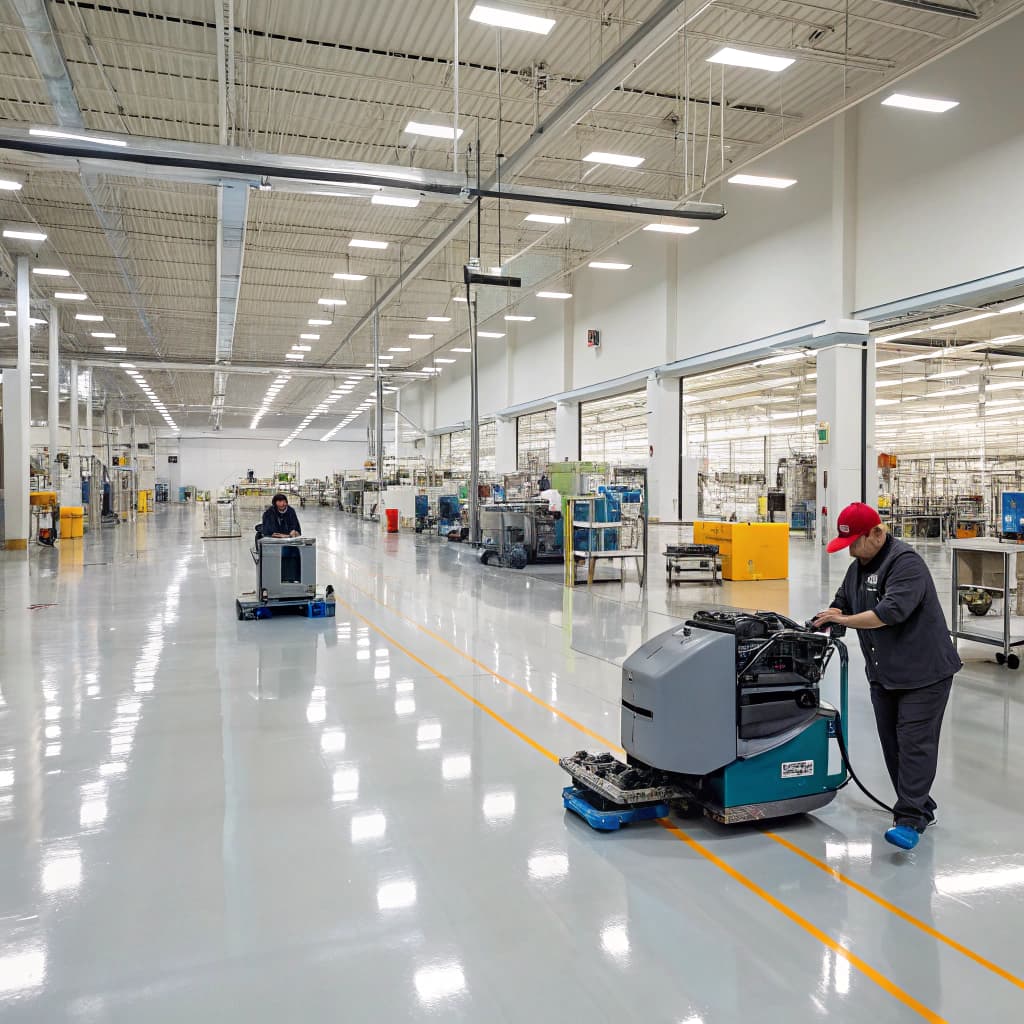
- Ride-on and walk-behind scrubbing of open floor and aisles
- Racking and shelving dust removal, worked top down
- Dock area cleaning, including seals, levelers and the apron outside
- Break room, restroom and office area janitorial
- Spill response for oil, hydraulic fluid and product
- Trash, pallet debris and shrink-wrap handling
- Light fixture and high surface cleaning on a rotation
Warehouse janitorial service and the office side
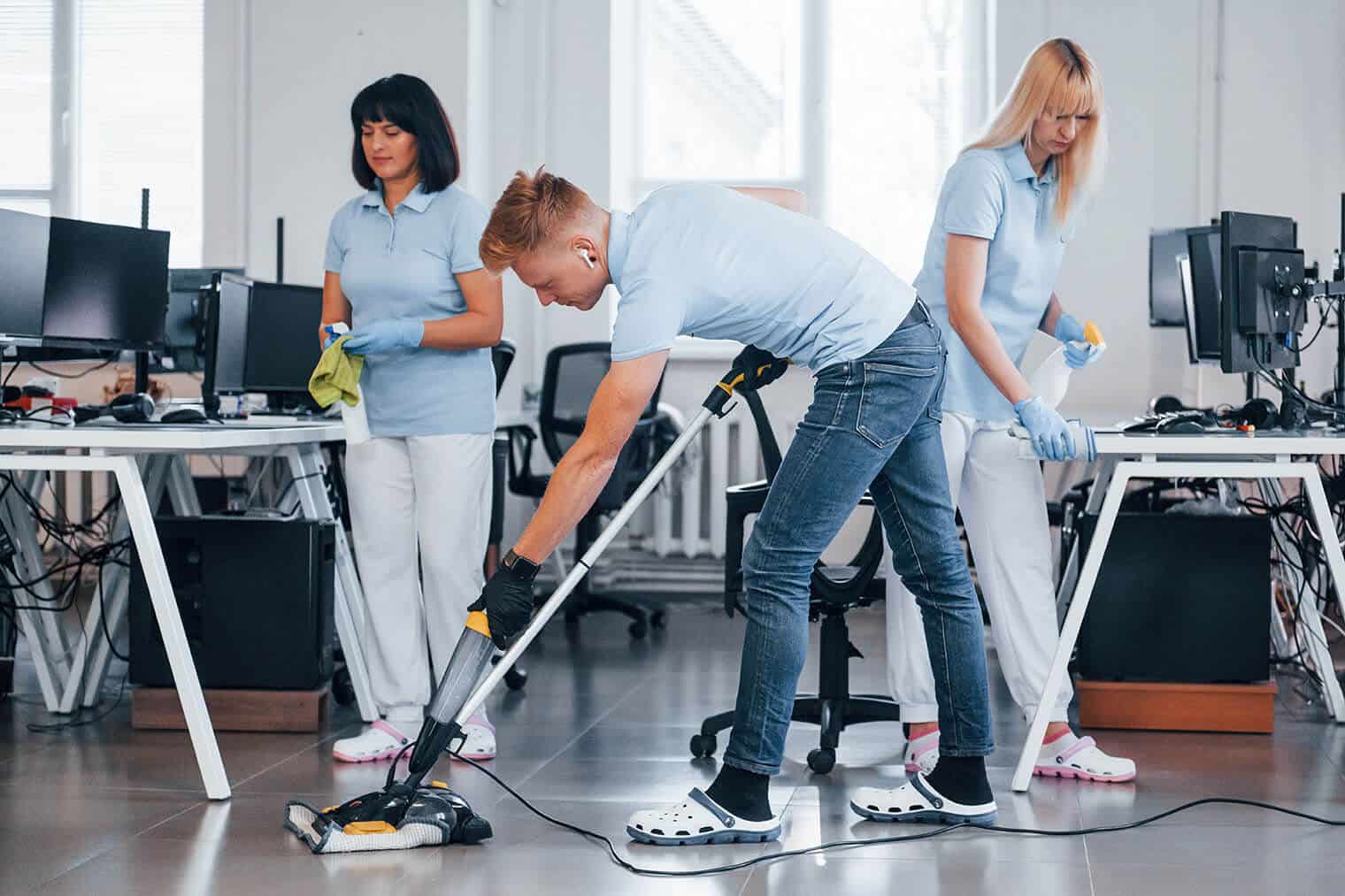
Most industrial buildings are two buildings. There is the floor, and there is the office, and a warehouse janitorial service has to be competent at both. Office areas need standard commercial janitorial: restrooms, break rooms, desks, glass and carpet. The floor needs machinery, height access and chemical knowledge.
Buildings that split these across two vendors usually end up with a seam where neither is responsible. We run both under one schedule, and our janitorial services in Orange County cover the office side of the same building.
Warehouse deep cleaning
Routine work maintains a condition. Warehouse deep cleaning changes it, and it needs downtime or a phased plan around production.
A deep pass typically includes degreasing the floor to bare substrate, high dusting across beams and joists, cleaning behind and beneath racking after product is pulled, full light fixture cleaning, and dust-collection and duct exterior work. Facilities running food, pharmaceutical or electronics product usually schedule this around a shutdown. Others phase it aisle by aisle across several weekends.
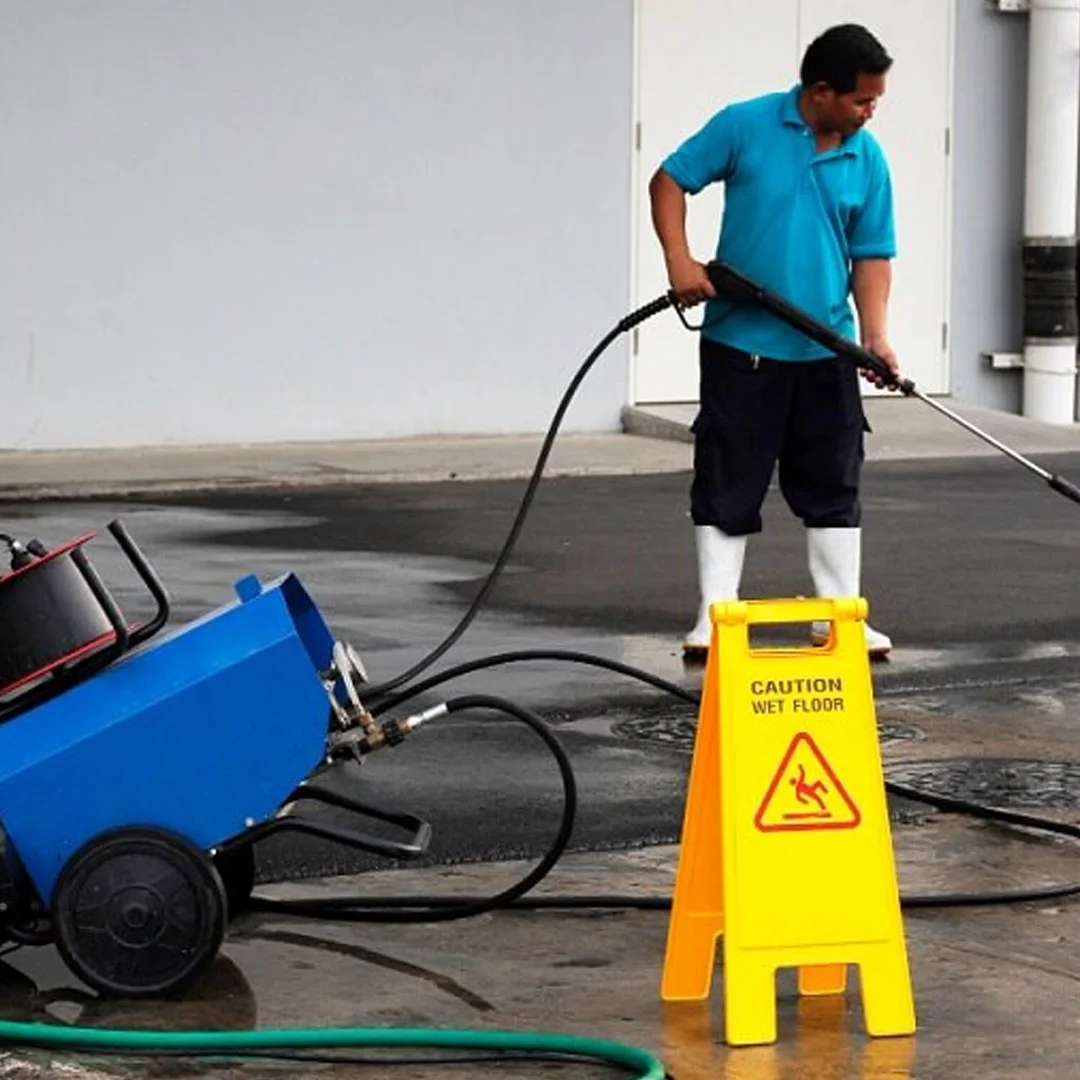
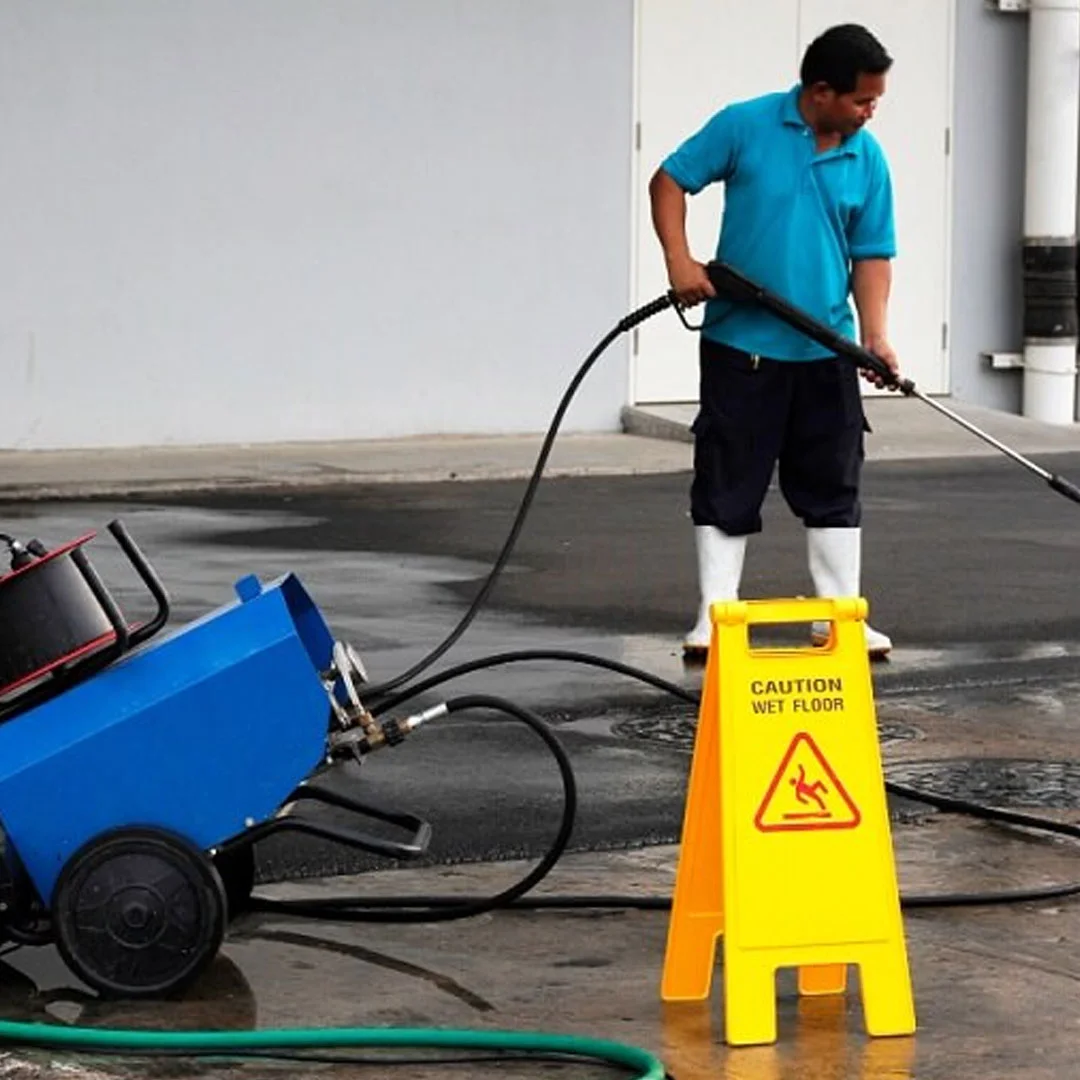
Our pressure washing in Orange County handles the exterior half, including dock aprons, trash enclosures and truck courts.
Distribution centers and port-adjacent logistics
Orange County's distribution buildings feed off the ports to the north, and that traffic sets the cleaning problem. A distribution center running high inbound container volume takes in far more outside dirt than a static storage building. Every trailer brings road grit to the dock, and every pallet carries it inside.
High-turn distribution operations need dock and staging areas cleaned on the shortest cycle in the building. Aisles need scrubbing frequently enough that grit never establishes. Seasonal peaks change the math, and a building running double shifts through peak needs a schedule built for that, not the one that worked in March.
Manufacturing floors and production areas
Production buildings need cleaning that respects the process running in them. Machining generates metal fines that travel further than most operators expect and behave abrasively wherever they land. Assembly and packaging lines shed fiber and film. Any of it settling on product or into a machine tolerance becomes a quality problem rather than a housekeeping one.
Production floors also carry oil in ways storage buildings do not. Coolant mist settles on surrounding surfaces, and walkways next to machinery collect a film that turns slick long before it looks dirty. These areas need degreasing on a set interval and a slip-resistant approach to the finish rather than a high-gloss one.
We coordinate around lockout and access requirements, and we keep cleaning equipment and chemicals clear of machine tolerances and control cabinets. Crews assigned to production floors work the same building consistently, because knowing which surfaces belong to the process and which belong to us prevents expensive mistakes.
Food-adjacent and product-quality standards
Buildings that store or handle food, packaging, or pharmaceutical product carry obligations beyond appearance. Contamination risk runs through pests, standing water, residue and cross-contact, and all four are cleaning problems before they are compliance problems.
OSHA's materials handling standard, 29 CFR 1910.176(c), requires storage areas to be kept free from accumulation of materials that create hazards from tripping, fire, explosion or pest harborage. Accumulated debris and spilled product are exactly what that language covers, and pest harborage in a food-adjacent building escalates quickly from a housekeeping issue to a product hold.
We work to the sanitation expectations of the product in your building. That means documented cleaning, controlled chemical selection near food contact zones, and attention to the floor-wall junctions and drains where residue actually collects.
Industrial cleaning scope
| Cadence | Scope |
|---|---|
| Daily | Dock and staging areas, break rooms, restrooms, office janitorial, spill response, trash |
| Weekly | Aisle scrubbing, dock seal and leveler cleaning, exterior apron sweep, first-level rack dusting |
| Monthly | Full floor scrub, upper racking dust removal, light fixture cleaning, floor-wall junctions and drains |
| Quarterly | High dusting on beams and joists, behind-rack cleaning, dust collection exteriors, degreasing |
| Annually | Deep clean to substrate, sealing or recoating where required, full high-bay service |
Frequently Asked Questions
Do you clean around active operations?
Yes. Most Orange County industrial buildings we service cannot stop, so we schedule around shifts and work in zones. Aisle scrubbing runs during low-traffic windows, dock work fits between inbound waves, and high dusting is scheduled aisle by aisle so product stays covered or clear. We build the sequence during the walkthrough with your operations lead.
What does warehouse cleaning cost?
Cost tracks square footage, floor type and condition, ceiling height, how much racking needs dusting, and the service frequency you need. A clean-swept storage building costs less than a manufacturing floor with oil load. Buildings needing after-hours or weekend access price differently again. We quote after walking the building, since photographs never show floor condition accurately.
Can you remove oil and grease from concrete?
Yes, though results depend on how long the oil has been there and whether the slab was sealed. Fresh spills lift readily with degreasing and mechanical agitation. Oil that has soaked into unsealed concrete for years may lighten substantially without disappearing entirely. We assess the slab first and tell you what is realistic before starting.
How often should racking be dusted?
Most buildings run first-level rack dusting weekly and upper levels monthly, with a full top-down pass quarterly. Facilities with product sensitivity, high air movement or nearby manufacturing usually need tighter intervals. Dust falls, so racking above a pick face matters more than racking above empty floor.
Do you handle warehouse deep cleaning during a shutdown?
Yes. Shutdown work is where deep cleaning belongs, because floors can be degreased properly and racking can be cleaned with product pulled. We staff shutdowns as a project with a defined scope and completion window, and we sequence the work so the areas you need first come back online first.
Do you serve food storage and packaging facilities?
Yes. Food-adjacent buildings need documented cleaning, controlled chemical selection near product zones, and close attention to drains, floor-wall junctions and pest harborage points. We adjust products and procedures to the product in the building rather than applying a general industrial routine, and we keep records of what was cleaned and when.