Cleaning Services for Hospitals In Orange County California
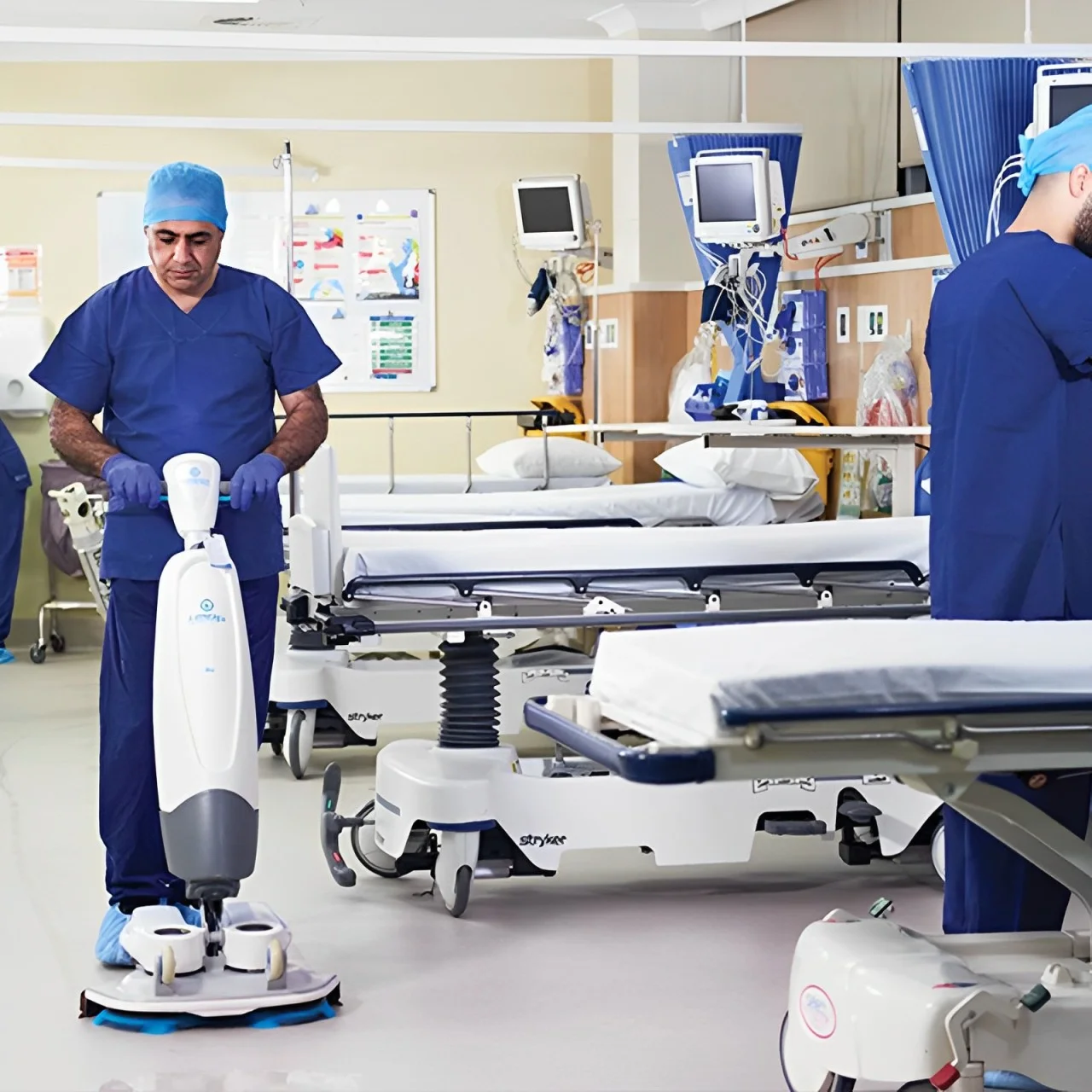
866SaniClean provides hospital cleaning services across Orange County for acute care buildings, surgery centers, outpatient clinics and medical office buildings.
Terminal cleaning and operating room intervals
Healthcare environments are graded on infection risk rather than appearance, so the work is defined by protocol, product selection and documented cycles rather than by how a room looks at the end of a shift.
We have run commercial cleaning as a family business since 1979. Every healthcare account is built around the risk level of each space, because a waiting room and an operating room do not belong on the same routine.
Terminal cleaning is the cleaning and disinfection performed after a patient is discharged or transferred, and it covers the removal of organic material along with a significant reduction of microbial contamination. It is the reset that makes a room safe for the next occupant, and it is the procedure most often shortened when a facility is under pressure for bed turnover.
Operating rooms follow a stricter rhythm. Surgical environments are cleaned at three distinct points in the day: before the first procedure, between procedures, and after the last case, which is the terminal clean. Each interval has a different scope. Between-case cleaning targets the sterile field perimeter, contact surfaces and floors within the immediate area. Terminal cleaning extends to the whole room, including surfaces above and below the working zone that between-case work does not reach.
Order matters in every one of these. A surface has to be cleaned before it is disinfected, because soil physically blocks the disinfectant from reaching the surface. Skipping the clean and going straight to disinfection is the most common failure we are asked to correct.
Outpatient clinics and surgery centers
Most healthcare cleaning demand in Orange County is not inside a hospital. It is in ambulatory surgery centers, imaging suites, dialysis clinics, dental and specialty practices, and multi-tenant medical office buildings.
These facilities carry hospital-level infection risk on a commercial building's schedule. A surgery center may run procedures until early evening and open again at six. The cleaning window is narrow and non-negotiable, and the work still has to cover procedure rooms, recovery bays, sterile processing corridors and public areas.
Clinics have a different problem: continuous throughput with no natural gap. Exam rooms turn over every fifteen minutes, and the between-patient wipe-down is done by clinical staff. What we handle is the terminal work at close, the high-touch cycles through the day, and the public areas that clinical staff never get to. Many buildings pair this with day porter coverage so waiting rooms and restrooms stay maintained while the clinic is open.
Infection control protocols and high-touch cycles
High-touch surfaces carry the transmission risk, and they are rarely the surfaces that look dirty. Bed rails, call buttons, IV poles, door handles, light switches, chair arms, counter edges, keyboards and shared equipment need frequency rather than intensity.
We work in a defined direction: clean to dirty, high to low, and never return a used cloth to a clean solution. Color-coded microfiber separates restrooms from patient areas from public spaces, which removes the judgment call that causes cross-contamination. Cloths and mop heads are changed between rooms rather than between wings.
Isolation rooms follow their own procedure, with dedicated equipment, appropriate personal protective equipment, and disposal handled to the facility's protocol rather than ours. We work to the infection prevention program your facility already operates, since that is the document your surveyors will hold you to.
Disinfectant selection and contact time
Product choice is a clinical decision, not a purchasing one. EPA's List N identifies disinfectant products expected to kill SARS-CoV-2 when used according to label directions, and the label also specifies the contact time the surface must remain visibly wet for the claim to hold. A product rated for four minutes that is wiped dry in thirty seconds has not disinfected anything.
Different pathogens need different chemistry. Products effective against enveloped viruses are not necessarily effective against bacterial spores, and facilities dealing with C. difficile need a sporicidal product with its own dwell requirements. We match the product to the organism of concern and the surface it will contact, and we train crews on dwell time as a hard requirement rather than a guideline.
Surface compatibility matters alongside efficacy. Aggressive chemistry degrades vinyl upholstery, equipment housings and laminate over time, and replacing exam room furniture is expensive.
Choosing a medical cleaning company in Orange County
Facility managers evaluating a medical cleaning company should ask about staffing before anything else. Healthcare cleaning quality tracks crew tenure more closely than it tracks equipment, because protocol adherence is learned and reinforced on site.
Ask how a hospital cleaning company handles supervision and verification. Cleaning that is not checked drifts, and the drift is invisible until an audit or an infection cluster surfaces it. Ask what documentation you receive, since surveyors want records rather than assurances.
For a surgery cleaning company the specific question is turnaround discipline. Between-case cleaning has a clock on it, and a crew that cannot hit the window reliably will either slow your schedule or cut the scope. Ask what happens when a case runs long and the schedule compresses.
Ask about coverage during absence as well. A missed shift in an office building is an inconvenience; a missed terminal clean is a patient safety issue.
Healthcare cleaning scope
| Cadence | Scope |
|---|---|
| Continuous | High-touch disinfection, restroom checks, spill and spill-kit response, waiting area resets |
| Nightly | Terminal cleaning of assigned rooms, floors, exam and procedure rooms, public areas, trash and regulated waste staging |
| Weekly | Detail work on fixtures and vents, wall spot cleaning, equipment exteriors, storage and utility rooms |
| Monthly | High dusting, curtain inspection and change-out, floor machine work, drain treatment |
| Quarterly | Deep floor restoration, upholstery extraction, full vent and grille cleaning, comprehensive detail pass |
Frequently Asked Questions
Do you provide cleaning services for hospitals and surgery centers?
Yes. We service acute care buildings, ambulatory surgery centers, outpatient clinics, imaging and dialysis suites, and multi-tenant medical office buildings across Orange County. Scope is built by risk level, so operating and procedure rooms follow stricter protocols and tighter documentation than administrative and public areas within the same building.
What is terminal cleaning?
Terminal cleaning is the cleaning and disinfection carried out after a patient is discharged or transferred, or after the last surgical case of the day. It removes organic material and substantially reduces microbial contamination, covering the full room rather than the contact surfaces addressed between patients. It is what makes a room ready for its next occupant.
How do you prevent cross-contamination between rooms?
Crews work clean to dirty and high to low, and never return a used cloth to a clean solution. Color-coded microfiber keeps restroom, patient area and public space materials separate, and cloths and mop heads change between rooms. Isolation rooms use dedicated equipment and follow your facility's own protocol for protective equipment and disposal.
Can you work around our surgery schedule?
Yes. Surgery centers run narrow cleaning windows between the last case and the next morning's first, so we staff to that window rather than a standard night route. When a case runs long we adjust sequence rather than reduce scope, prioritizing procedure rooms and sterile corridors first and completing administrative areas afterwards.
What disinfectants do you use in healthcare spaces?
We use EPA-registered disinfectants matched to the organism of concern and the surface being treated, and we hold the contact time printed on the product label. Facilities managing spore-forming organisms such as C. difficile need sporicidal products with their own dwell requirements. Surface compatibility is part of the selection, since harsh chemistry degrades upholstery and equipment housings over time.
Do you document the cleaning you perform?
Yes. We record what was cleaned, when, and by whom, at the level of detail your facility requires. Documentation matters most for terminal cleaning and isolation rooms, where the record is what demonstrates the procedure occurred. We align our records with your existing infection prevention program rather than introducing a parallel system.